Mala, Rosary, Juzu and Misbaha: How Prayer Beads Compare Across Traditions
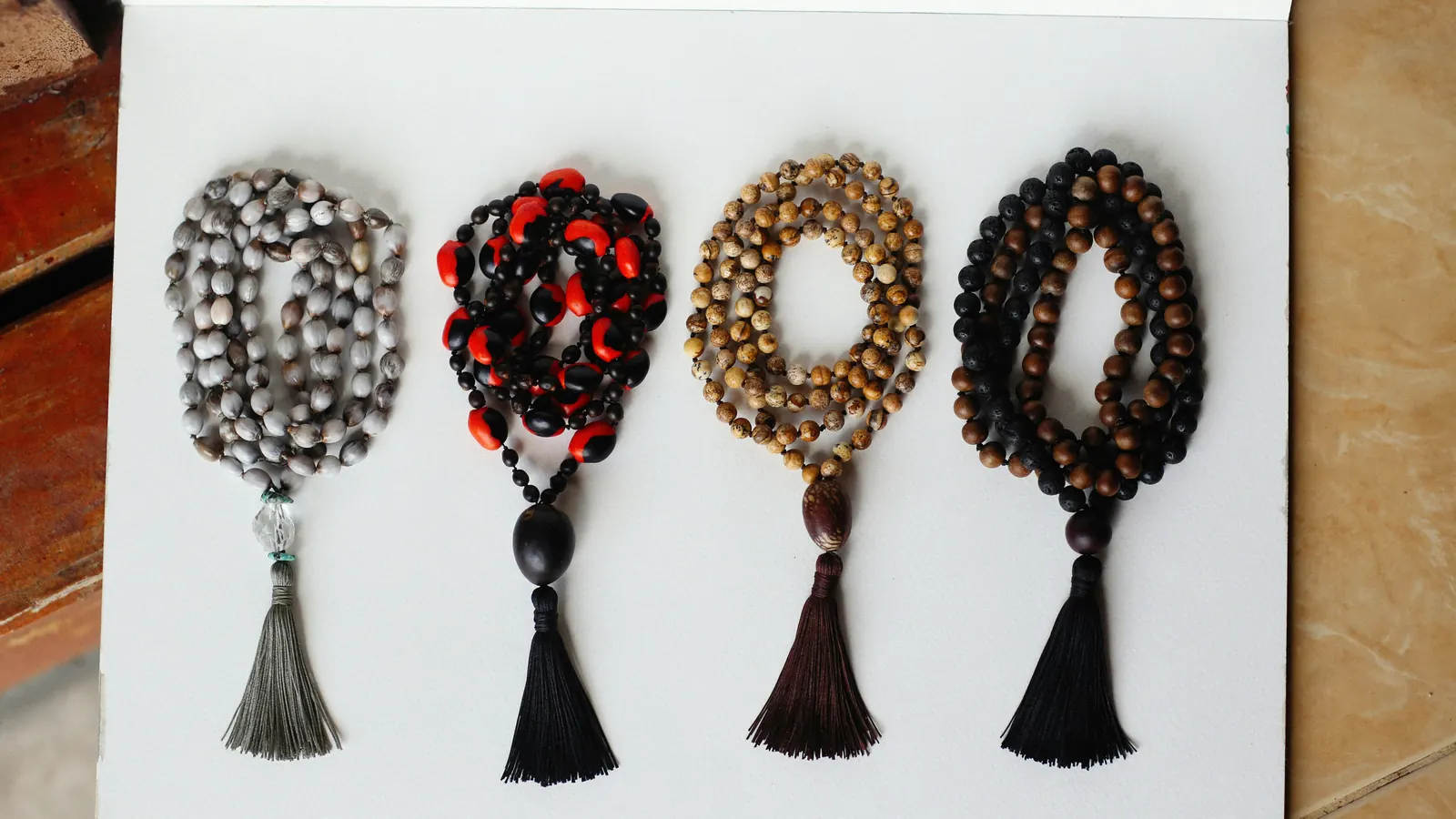
Prayer beads show up in nearly every major religion. A Tibetan Buddhist reciting a mantra, a Catholic praying the rosary, a Japanese Buddhist at a temple and a Muslim giving thanks after prayer may all be moving beads through their fingers. The strands can look alike, but each belongs to its own tradition, with its own words and meaning. Here is how four of the best-known kinds compare.
Why so many traditions use beads
Many faiths include prayers or phrases that are meant to be repeated many times. Beads keep the count, so attention can stay on the prayer itself instead of on the numbers. The shape of the strand, the number of beads and the words said on them are where the traditions differ.
The mala in Hindu and Buddhist practice
The mala is used in Hinduism and Buddhism to count mantras, prayers and, for some Buddhists, prostrations. A full mala usually has 108 beads plus a larger guru bead that marks the start and end of a round and is not counted. Many practitioners turn the mala around at the guru bead rather than pass over it. Shorter wrist malas of 27 or 54 beads are common too.
Materials can carry meaning. Rudraksha beads are sacred to devotees of Shiva, and tulsi wood is revered by devotees of Vishnu. Malas sold as "bodhi seed" are popular with Mahayana Buddhists. For more, see What Are Bodhi Beads? Their Meaning, History, and How People Use Them.
The juzu in Japanese Buddhism
In Japan, Buddhist prayer beads are called juzu or nenju. Their design varies by school, so a juzu from one temple may look quite different from another. They are used to count recitations, such as the nembutsu in Pure Land practice, and prostrations, and they also mark the wearer as someone following the Buddhist path.
The Nichiren Shu school, for example, uses a juzu of 108 beads with five tassels, three on one side and two on the other. Some of its larger beads stand for particular Buddhas. Other schools have their own customs. In Jodo Shinshu, for instance, the beads are not rubbed together.
The rosary in Catholic practice
The Catholic rosary is a loop of five decades, each a set of ten beads, separated by larger beads, with a crucifix and a few more beads at the end. The Hail Mary is said on the small beads, and the Our Father and Glory Be on the larger ones. While praying, Catholics meditate on events in the lives of Jesus and Mary, known as the mysteries. These are grouped as joyful, sorrowful and glorious, and Pope John Paul II added the luminous mysteries in 2002.
Tradition links the rosary to St. Dominic in the early 13th century, though its true origin is uncertain. It took its familiar form in the 15th century.
Other Christians have their own beads. Eastern Orthodox Christians use a prayer rope, usually knotted, with 33, 100 or 300 knots or beads, to repeat the Jesus Prayer. Anglican prayer beads draw on both Orthodox and Catholic designs.
The misbaha in Islam
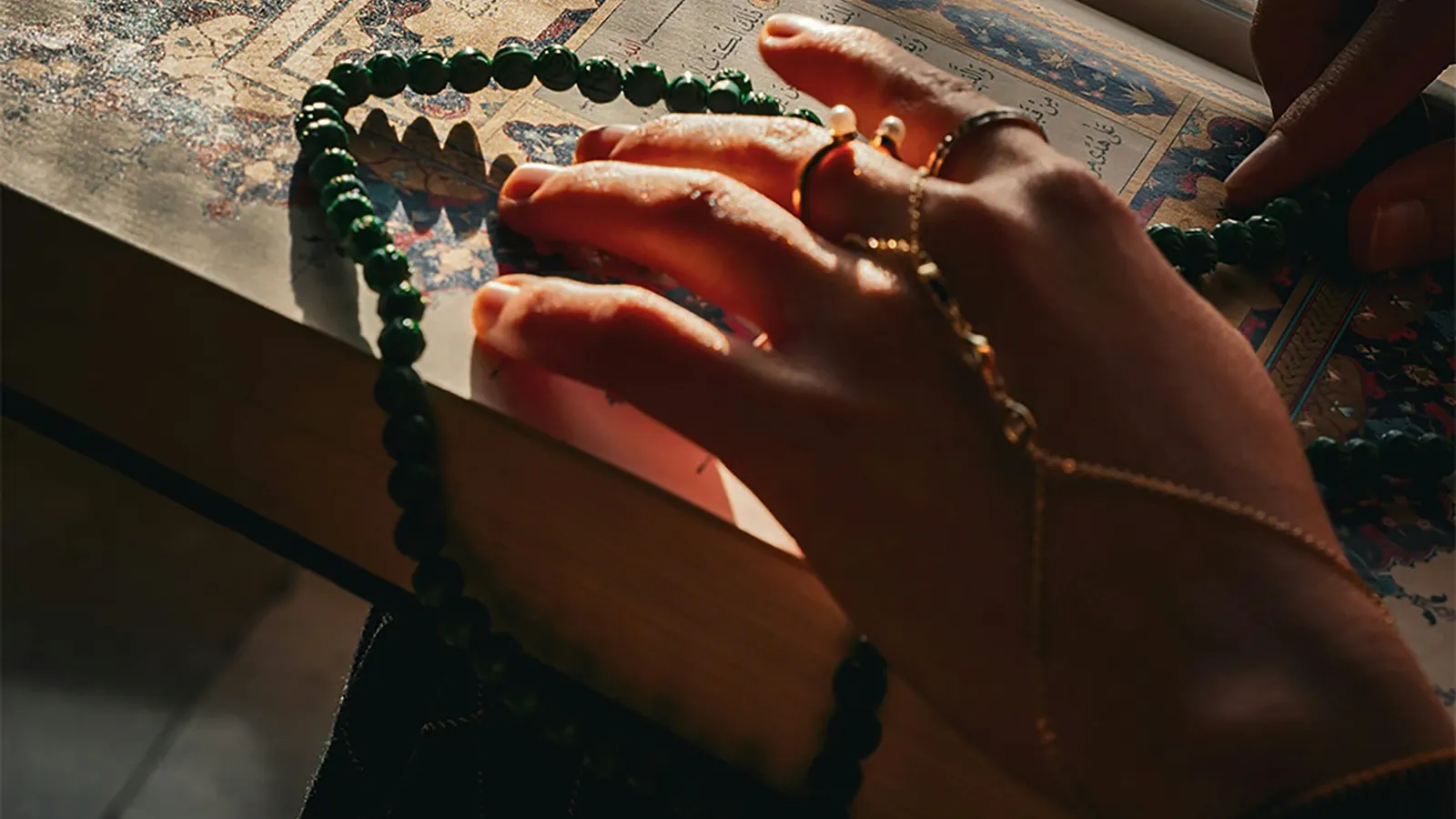
The misbaha, also called subha, tasbih or tespih depending on the region, is used for dhikr, the remembrance of God, especially after daily prayers. It commonly has 99 or 100 beads in three sections, or a short strand of 33 that is gone around three times. Separator beads divide the sections, and a longer piece often serves as a handle.
A common practice is to repeat three phrases 33 times each, "Subhan Allah" (Glory be to God), "Alhamdulillah" (Praise be to God) and "Allahu Akbar" (God is greatest), with the last sometimes said 34 times. Many Muslims carry a misbaha, especially pilgrims. Others prefer to count on their fingers, and some see the beads as an innovation that is best avoided.
At a glance
| Beads | Tradition | Usual count | What is counted | A distinctive feature |
|---|---|---|---|---|
| Mala | Hindu and Buddhist | 108 plus a guru bead, or 27 or 54 | Mantras, prayers, prostrations | The guru bead is not crossed |
| Juzu | Japanese Buddhist | Often 108, varies by school | Recitations such as the nembutsu, prostrations | Design differs from school to school |
| Rosary | Catholic | Five decades of ten | Hail Marys, with the Our Father and Glory Be | Meditation on the mysteries |
| Misbaha | Muslim | 99 or 100 in three sections, or 33 | Phrases praising God | Separator beads and a handle |
What they share, and what they do not
All four help people pray with attention and keep their place. All four are treated with care by the people who use them. But they are not simply versions of one object. The words, the beliefs behind them and the way each is used belong to its own tradition. It is better to learn each one on its own terms than to treat a rosary as a "Christian mala" or a misbaha as an "Islamic rosary."
If you are curious about using prayer beads from a tradition that is not your own, Can You Use or Wear a Mala If You Are Not Buddhist or Hindu? A Respectful Guide offers some thoughtful starting points.
A last word
Across many faiths and many centuries, people have found that a simple string of beads can steady the mind in prayer. Knowing how each tradition uses its beads is a small way to honor all of them. To learn what your own mala is made of, read Are Bodhi Beads Really From the Bodhi Tree? What They're Made Of and How to Tell What Yours Is.
Sources
- Encyclopaedia Britannica. Rosary. https://www.britannica.com/topic/rosary (opens in a new tab)
- Wikipedia. Japamala. https://en.wikipedia.org/wiki/Japamala (opens in a new tab)
- Wikipedia. Misbaha. https://en.wikipedia.org/wiki/Misbaha (opens in a new tab)
- Nichiren Shu. Juzu. https://www.nichiren.or.jp/english/buddhism/juzu/ (opens in a new tab)