Can You Use or Wear a Mala If You Are Not Buddhist or Hindu? A Respectful Guide
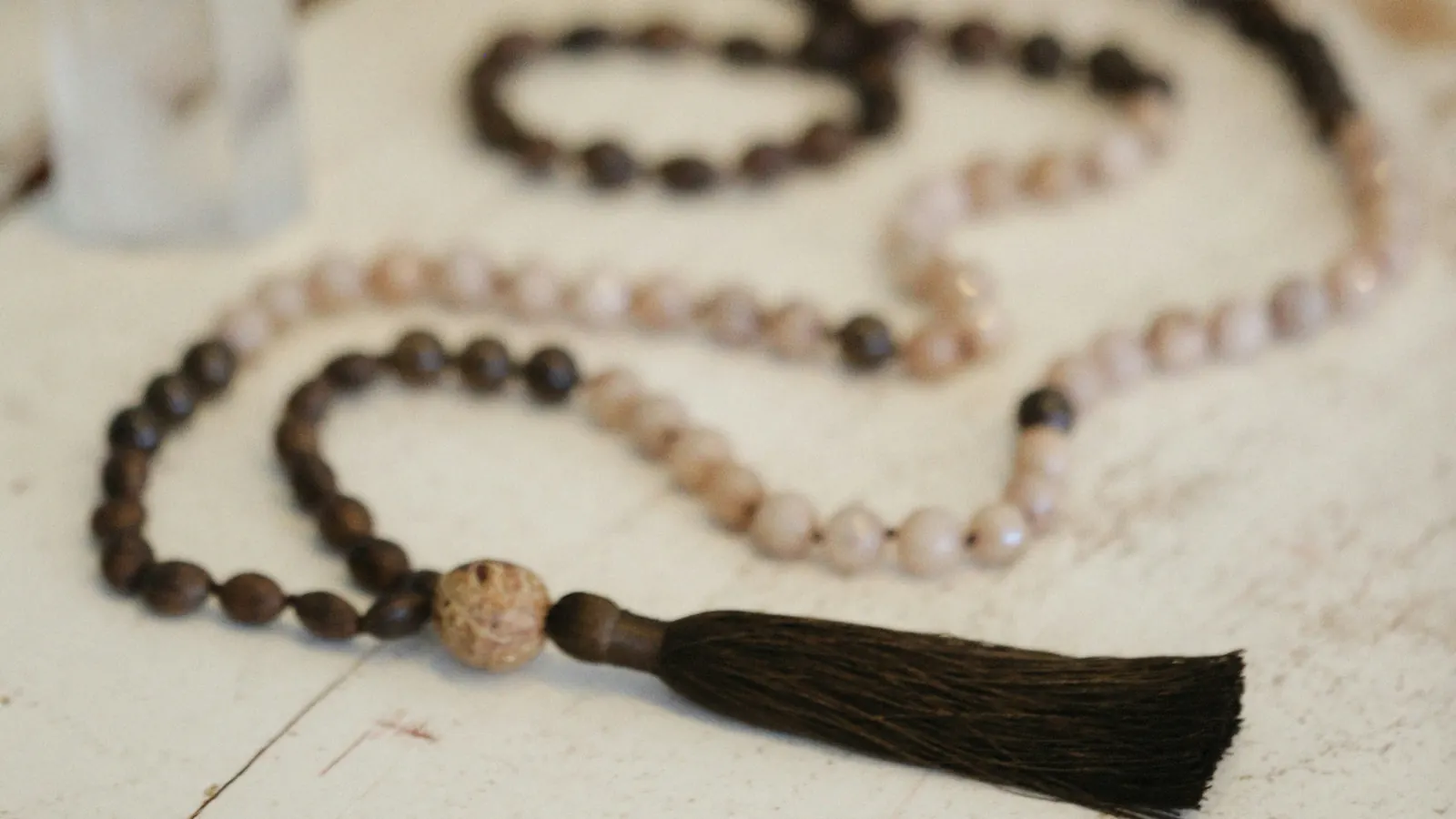
Maybe a friend gave you a mala, or you have been drawn to one for your own quiet time and wondered whether it is yours to use. It is a fair question, and asking it is already a good sign. The short answer is yes. The Tibetan Nuns Project, a nonprofit that supports Buddhist nuns, says plainly that you do not have to be a Buddhist to wear one. What matters most is how you treat it.
Why the question matters
A mala is not only a necklace. It is a religious object in traditions that are very much alive, and for many people it is part of daily prayer.
In Buddhism, the mala is used to count mantras and prayers, and the writer Clark Strand notes that every tradition asks for beads to be cared for "as if they were a precious sutra or a Buddhist robe." He also points out that prayer beads were mostly made for laypeople, not only for monks and nuns. So a mala has always been meant for ordinary hands, as long as those hands are respectful.
In Hinduism, the material of a mala can carry its own meaning. Rudraksha beads are sacred to Shaivas, who are devotees of Shiva, and tulsi wood is revered by Vaishnavas, who follow Vishnu. Hare Krishna devotees chant the names of Krishna on their beads. A strand that looks like a simple accessory may be, to someone else, a tool of devotion tied to a particular god and community.
Knowing this is the difference between borrowing a symbol and appreciating it.
What respectful use looks like
You do not need to convert, take vows or follow every rule of a lineage to use a mala well. A few habits go a long way:
- Learn what it is. Know where malas come from and what the beads mean. What Are Bodhi Beads? Their Meaning, History, and How People Use Them is a good start.
- Use it for its purpose. A mala is made for counting, whether mantras, prayers or breaths. Even a simple, mantra-free practice like Counting Breaths with Beads: A Five-Minute Practice for Beginners keeps it close to what it was made for.
- Handle it with care. Keep it off the floor, take it off before bathing, remove it before sleep, and store it in a pouch or a clean place.
- Honor the guru bead. When you reach the larger bead, turn the mala around rather than passing over it, as many Buddhist and Hindu practitioners do.
- Know your materials. Buy from sellers who are honest about what the beads are and where they come from. Are Bodhi Beads Really From the Bodhi Tree? What They're Made Of and How to Tell What Yours Is explains why that matters.
Choosing words to count
If you want to recite something on your beads, take a little care with what you choose. A traditional mantra belongs to a tradition and often to a specific practice within it. If you use one, learn what it means and where it comes from, and ideally learn it from someone who practices it.
If that feels like too much for now, you have good options. You can count breaths in silence, repeat a plain word or phrase that means something to you, or count prayers from your own faith. None of these takes anything from anyone.
What to avoid
A little thought here keeps your practice respectful:
- Using it only as a costume. Wearing a mala is fine. Wearing one while knowing nothing about it, or as part of a joke or a themed outfit, misses the point.
- Promising what the traditions do not. A mala is a counting tool for prayer and meditation. Claims that beads heal illness or fix your life are marketing, not teaching.
- Treating sacred materials lightly. Rudraksha and tulsi have specific devotional meaning. If you choose one, learn a little about the tradition it belongs to.
- Speaking for a tradition. It is fine to share what a mala means to you. Be careful about explaining Buddhist or Hindu practice to others as if you were a teacher of it.
If you follow another faith
Prayer beads are not unique to Buddhism and Hinduism. Christians have the rosary and the prayer rope, and many Muslims use the misbaha. Some people of other faiths use a mala to count their own prayers, and some prefer to stay with the beads of their own tradition. Views vary inside every faith, so if it matters to you, talk with a leader in your own community. For a side-by-side look, read Mala, Rosary, Juzu and Misbaha: How Prayer Beads Compare Across Traditions.
A last word
Respect is not about being perfect. It is about paying attention, learning a little, and treating something sacred to others with the same care you would want for what is sacred to you. If you hold your mala that way, you are welcome to it.
Sources
- Tibetan Nuns Project. How to use a Tibetan mala. https://tnp.org/how-to-use-tibetan-mala-prayer-beads (opens in a new tab)
- Strand, C. (2006, Winter). Worry beads. Tricycle: The Buddhist Review. https://tricycle.org/magazine/mala-beads/ (opens in a new tab)
- Encyclopaedia Britannica. Rosary. https://www.britannica.com/topic/rosary (opens in a new tab)
- Wikipedia. Japamala. https://en.wikipedia.org/wiki/Japamala (opens in a new tab)